WHAT IT DOES
The Escalade IQ-L is what happens when a legacy luxury nameplate decides the electric transition should feel like an escalation, not a sacrifice. On paper, it is almost cartoonishly outsized: roughly 228.5 inches long, 94.1 inches wide, and close to 9,000 pounds, with a 205 kWh battery pack that is nearly three times the capacity of a typical electric sedan’s. In practice, it presents itself less as a vehicle and more as a rolling lounge that happens to move at highway speeds.
Inside, the car is designed to dissolve any sense of constraint. A 55-inch curved 8K display stretches across the dash, flanked by passenger screens and second-row entertainment panels. Each row gets its own climate of comfort: heated and ventilated leather seats with extensive power adjustment, available massaging thrones in the middle row, stowable tray tables, dual wireless chargers, 5G Wi-Fi, and a 38-speaker AKG audio system that turns the cabin into a private cinema. Polarized screen tech lets front passengers binge video without bleeding into the driver’s sightline.
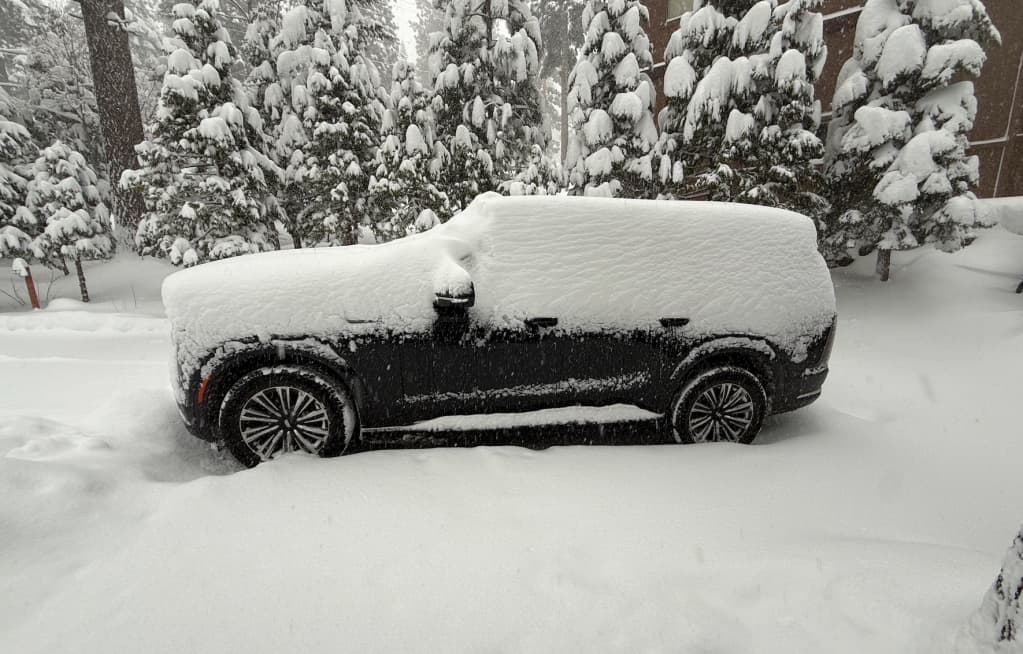
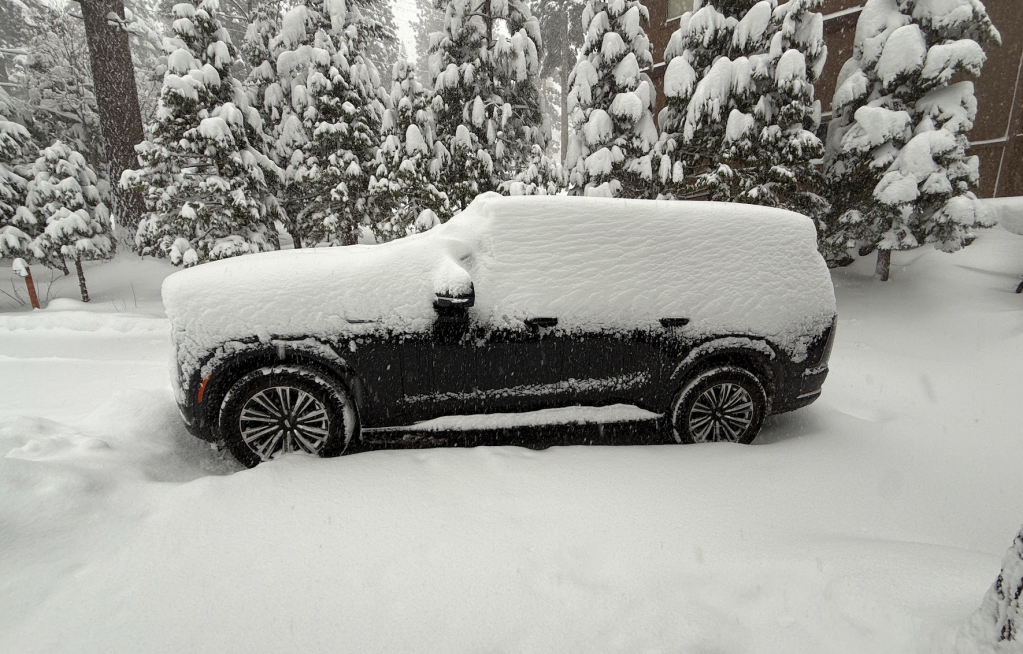
On the move, the Escalade attempts to make its bulk feel not just manageable but reassuring. Super Cruise, GM’s hands-free driving system, promises to offload much of the monotony of highway driving, even if it still demands frequent “driver takeover requests.” The massive battery aims to deliver an estimated 460 miles of range in ideal conditions, while the weight and low center of gravity of the EV platform turn deep snow into something closer to a backdrop than a threat. The result is a machine that sells a specific feeling: you and your passengers are insulated, entertained, and in control, no matter what is happening outside.
WHAT IT ABSORBS
Vehicles at this scale and spec don’t just move people; they move boundaries about what drivers are expected to manage themselves. The Escalade IQ-L quietly absorbs a set of human capabilities that used to be central to driving, family logistics, and even social self-regulation.
Start with spatial judgment and restraint. Historically, choosing a vehicle was a negotiation with limits: parking availability, urban streets, narrow driveways, and the discomfort of piloting a rolling wall through public space. In the Tahoe story, the initial reaction is visceral recoil – “this thing is a monstrosity” – followed by rapid acclimation. Cameras, sensors, assisted steering and a commanding seating position blunt the psychological friction of size. What once required continuous, skilled spatial awareness becomes something the car helps manage, until the owner stops mouthing apologies in parking lots and simply claims the space.
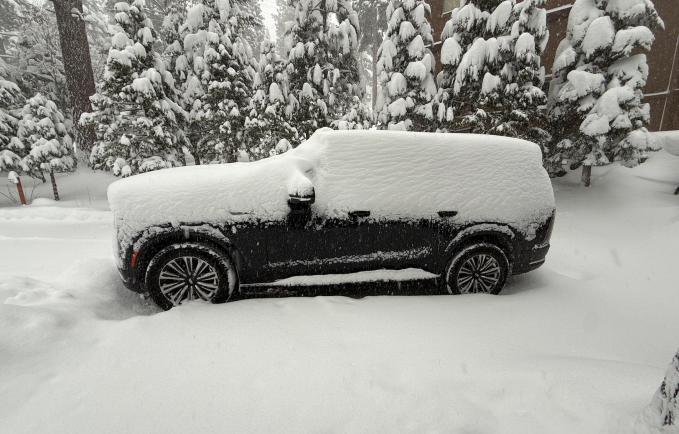
Winter driving skill is another capability being reconfigured. In snow country, staying mobile used to depend heavily on experience: reading the road surface, modulating throttle and braking, picking routes and speeds that matched conditions. Here, the sheer mass of a 9,000-pound EV with sophisticated traction control converts a potentially harrowing blizzard into a serene tank-like glide. The driver’s subjective fear diminishes not because they’ve become more adept, but because the vehicle’s physics and software shoulder more of the risk management. Snow competency is being repackaged from an earned skill into a purchasable feature.
Inside the cabin, the car takes over a set of low-level social and logistical tasks that families used to handle manually. Screens for every row, ever-present connectivity, and immersive audio turn long drives from coordinated group events into parallel individual experiences. Parents don’t have to entertain children; the car does. Navigation is outsourced to Google Maps; the MyCadillac app proposes charging options and status. The vehicle becomes both nanny and travel coordinator, smoothing frictions that once demanded attention and interpersonal negotiation.
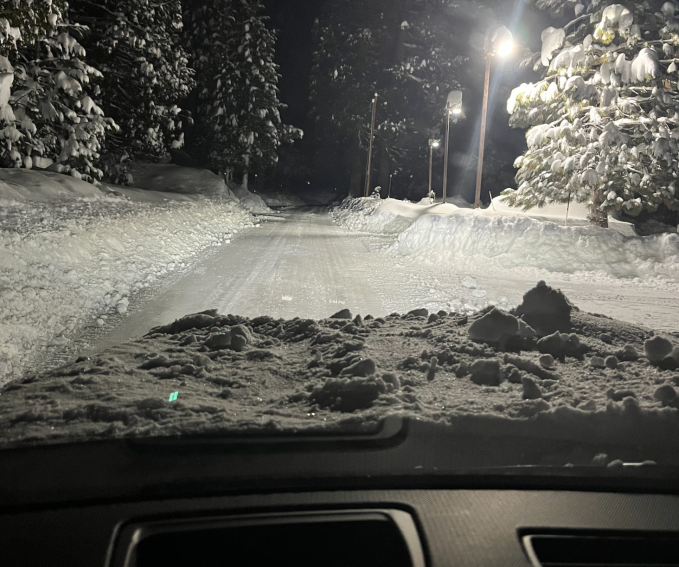
At the same time, the Escalade reveals the limits of this absorption. The frunk’s inconsistent behavior, the car refusing to power down, the patchwork charging experience in Tahoe – Tesla Superchargers that won’t meaningfully charge, broken ChargePoint units, a shuttered EVGo, and a late-night dash to an Electrify America station – all force the driver back into improvisation. Route planning, energy budgeting, and problem-solving in adverse conditions were supposed to be quietly handled in the background; instead, they resurface as high-stakes decisions at 11 p.m. in a snowstorm. The capability being targeted for automation – confident, infrastructure-aware trip management – is not yet reliably captured by the car or ecosystem, even as the driver increasingly trusts that it is.
Finally, the vehicle mutes traditional feedback loops between consumption and consequence. With an energy use around 45 kWh per 100 miles, the Escalade is an objectively inefficient EV. Yet the instant torque and quiet cabin obscure the effort involved in moving a 9,000-pound object through space. Where an overburdened combustion engine would audibly strain, this drivetrain remains composed. The driver’s mechanical sympathy – their intuitive sense of when something is “too much” – is dulled. That judgment, too, is being absorbed by abstractions: range estimates, battery percentages, and vague promises of nearby fast chargers.
WHO GAINS, WHO LOSES
The Escalade IQ-L shifts leverage among drivers, automakers, infrastructure providers, and everyone who has to share physical and political space with vehicles like it.
Affluent drivers in suburban or resort-adjacent environments gain the most immediate, tangible leverage. For them, snow-season mobility becomes far less dependent on skill, vehicle maintenance, or community infrastructure like plowing schedules and transit. If you can afford a 205 kWh battery on air suspension, eight feet of snow becomes an inconvenience rather than an immobilizing event. The vehicle converts volatility – storms, road conditions, cramped family trips – into a luxury experience. That stability is a form of power: the ability to keep moving, keep working, keep consuming when others pause.
GM and other legacy automakers gain leverage over the narrative of electrification. Instead of EVs as small, efficient, slightly hair-shirt alternatives, they can position the electric transition as an upgrade: more screens, more range, more mass, more status. The Escalade’s cabin is not an apology for going electric; it’s an argument that “green” can be bigger, quieter, and more indulgent than what came before. This preserves a profitable business model based on oversized, high-margin SUVs, now insulated by zero-tailpipe-emissions branding.
Technology platforms embedded in the car also gain. Google, connectivity providers, and GM’s own software stack capture the driver’s attention, data, and expectations. As drivers grow accustomed to the car handling navigation, entertainment, and partial driving tasks, their dependence on these platforms deepens. The vehicle becomes another node in the broader attention economy, with a captive audience sealed behind sound-deadened glass for hours at a time.
On the losing side, the ordinary constraints of shared space take the hit. Urban streets, parking lots, and driveways must now accommodate 228 inches of metal that sits high enough to create significant forward blind zones. For pedestrians and smaller vehicles, each additional 9,000-pound SUV on the road increases both physical risk and perceived intimidation. Infrastructure designed around lighter, smaller vehicles – from parking garage ramps to residential streets – quietly becomes misaligned with the new normal.
The energy and charging ecosystem absorbs another kind of strain. A single Escalade IQ-L can draw as much power to fast-charge as several compact EVs combined. In winter, when batteries are less efficient and grid demand spikes for heating, these vehicles turn “just top up the car” into a serious load event. Where charging networks are fragmented or fragile, as the Tahoe trip showed, drivers are pushed into late-night, long-distance hunts for working high-speed chargers. The burden shifts from the manufacturer – who sells the promise of effortless range – to infrastructure operators and local grids that must quietly absorb or fail under the cumulative demand.
There is also a subtle loss for drivers themselves: agency over their own relationship with resource use. When a 9,000-pound “luxury tank” feels like the rational choice because it keeps your family serene in a blizzard, the space for choosing smaller, lighter, more collectively efficient options narrows. Individuals who care about consumption find themselves emotionally outmaneuvered by comfort, safety, and status signaling. The Escalade doesn’t just move its owner; it moves the boundary of what counts as acceptable excess in an electric age.
THE TRAJECTORY
If vehicles like the Escalade IQ-L succeed, they redefine the baseline expectation for electric mobility: not minimalism, but maximalism powered by lithium. Average EV size and battery capacity trend upward, and with them come cascading consequences.
On the infrastructure side, resort towns, exurbs, and highway corridors will be pressured to build more high-power DC fast-charging, not just more plugs. Grid planners will have to treat clusters of large EVs as meaningful peak loads, especially in winter. Charging reliability stops being a fringe enthusiast complaint and becomes a political issue for affluent constituents stranded in ski-town parking lots.
In design terms, the Escalade’s formula – vast interior, theater-grade entertainment, semi-automated highway driving – becomes an aspirational template. Family vehicles evolve into rolling living rooms first and transportation tools second. That, in turn, strengthens the commercial logic for further automation: if the cabin is already tuned for occupancy rather than driving, fully removing the need for a dedicated driver becomes the natural next step. The human presence behind the wheel shifts toward supervision and away from skill, until it becomes negotiable.
Politically, normalizing 9,000-pound “green” vehicles will likely provoke a delayed response. As streets fill with heavier EVs, regulators may look harder at weight-based road fees, stricter safety standards for front-end design, or differentiated rules for oversized passenger vehicles in dense areas. The friction that the vehicle’s technology currently suppresses – the sense that this might simply be too much car – could resurface as zoning debates, parking reforms, and emissions policies that look beyond tailpipes to total lifecycle impact.
The deeper trajectory is a cultural one. The Escalade IQ-L shows how quickly discomfort with excess can flip into desire once that excess is wrapped in competence and comfort, especially in moments of crisis like a whiteout drive. If that pattern scales, electrification won’t shrink our automotive footprint; it will provide moral cover to keep growing it. Snowproof, screen-filled comfort becomes the new status symbol, and the question quietly shifts from “Do we need this much?” to “Can you afford not to feel this safe and serene?” In that world, the hardest human capability to preserve isn’t driving skill or route planning; it’s the ability to choose “enough” when technology keeps redefining what more can buy.