Sonifying the Unheard Earth Reveals Both the Power and Peril of Data as Art
Thesis: Brian House’s translation of infrasound—subaudible pressure fluctuations from glaciers, storms, wildfires, and human infrastructure—into ambient compositions demonstrates how art can democratize environmental sensor data while surfacing ambiguities in attribution, processing transparency, and the boundary between scientific evidence and cultural experience.
Methods and Limits of Artistic Infrasound Capture
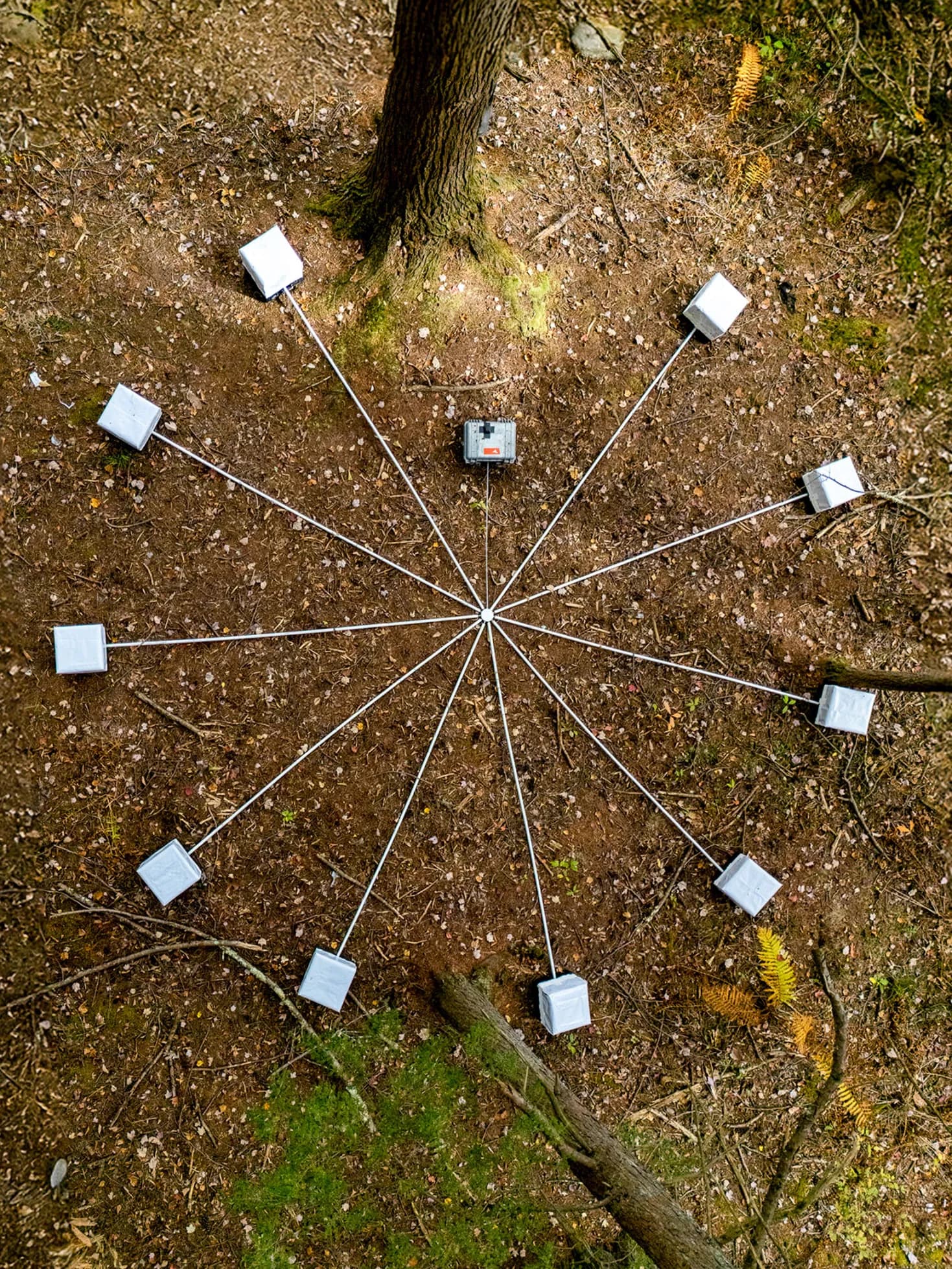
According to House’s artist notes, the project Everyday Infrasound in an Uncertain World relies on three self-built “macrophones”: wind-funnel sculptures roughly 20 ft in diameter that channel microbarometric fluctuations into a digital barometer sampled at 100 Hz. Over 24 hours, the raw pressure time series—capturing signals below the ~20 Hz hearing threshold—is recorded. House then accelerates the recording by a factor of approximately 60× and applies a multioctave pitch shift of about six octaves, compressing a full day into 24 minutes of audio.
These artistic transformations introduce substantial deviations from scientific infrasound data. Time acceleration alters low-frequency envelope shapes, masking gradual amplitude modulations, while pitch shifting changes harmonic content, creating spectral artifacts absent in unprocessed recordings. Additional filtering and equalization—applied to enhance sonic clarity in a gallery context—further reshape bandwidth and noise profiles. Consequently, the resulting tracks function as aesthetic renderings rather than direct substitutes for calibrated geophysical measurements.

House acknowledges—and collaborators in infrasound research confirm—that identifying specific sources remains provisional. Signals are described as plausibly from glacier calving, wildfire plumes, storm fronts, distant trains or HVAC systems. Without cross-array triangulation, GPS-synchronized timestamps, or standardized documentation of sensor calibration, event attribution must be treated as tentative. The absence of a verifiable metadata chain—covering sensor sensitivity, filter roll-offs, and exact acceleration factors—limits both reproducibility and scientific validation.
Context: At the Intersection of Environmental Science and Cultural Meaning
Infrasound sensing has long underpinned global monitoring networks, from barometric observations of the 1883 Krakatoa eruption to modern arrays used by the Comprehensive Nuclear-Test-Ban Treaty Organisation (CTBTO) to detect distant explosions or volcanic eruptions. Such systems emphasize precision: calibrated sensors, cross-array signal processing, and inverse modeling to locate and quantify events.
By contrast, House’s project emerges from a lineage of data art and field recording that prioritizes experiential resonance over quantitative accuracy. Past examples include seismic sonifications in seismology outreach and ambient translations of oceanographic data, but most scientific sonifications preserve traceability of raw signals. House flips the paradigm: the earth’s subsurface rhythms become ambient soundscapes stripped of positional context, inviting audiences to inhabit a climate crisis through texture and tone rather than through numeric metrics.
The political dimension of this reframing is significant. Making infrasound perceptible transforms the silent, planetary scale of climate phenomena into an embodied encounter. This aestheticization carries implications for how communities narrate environmental change—and for whose voices shape that narrative. The shift from operational telemetry to cultural artifact elevates affective experience, yet it also risks obscuring the rigorous frameworks that underpin scientific consensus.
Implications: Democratizing Data, Eroding Certainty
- Cultural Agency and Collective Imagination: Sonification invites nontechnical audiences—museum visitors, climate activists, community groups—to engage with geophysical processes as cultural material. This recontextualization can foster new forms of belonging and shared concern around planetary change.
- Ambiguity in Attribution: The aesthetic layer may imply definitive event identification where none exists. Listeners could perceive glacier events or wildfires as pinpointed phenomena, overlooking the provisional nature of source labeling without sensor triangulation or corroborating visual data.
- Transparency as Trust Currency: Opaque processing choices—acceleration scales, filter bands, equalization curves—shape the audience’s perceptual reality. Without openly disclosed metadata, stakeholders may conflate artistic effect with empirical signal, complicating efforts to ground policy decisions in robust evidence.
- Equity in Environmental Sensing: Low-cost macrophone setups lower barriers to community-driven environmental listening, enabling grassroots participation in data collection as cultural practice. Yet contexts without access to established sensor networks or verification tools may struggle to situate aesthetic outputs within credible environmental narratives.
Opportunities for Cross-Disciplinary Synergy
- Hybrid Calibration Frameworks: Pairing artists with infrasound specialists could integrate portable macrophone prototypes into calibrated arrays. Such collaborations might yield outputs that retain sonic richness while embedding geolocation and amplitude fidelity, bridging art and science.
- Embedded Metadata in Exhibitions: Galleries and public installations could juxtapose sonified tracks with interactive displays of raw infrasound waveforms, filter parameters, and acceleration factors. This layered presentation would enable audiences to toggle between scientific and aesthetic perspectives, revealing how processing shapes perception.
- Research on Interpretive Impact: Empirical studies of listener interpretation can uncover how sonified environmental signals influence beliefs about climate phenomena. Insights from cognitive science and science communication could inform guidelines for presenting data art in civic contexts.
- Policy Engagement through Aesthetics: Cultural institutions and policy forums might convene artists, scientists, and community members to co-author narratives around environmental data. This inclusive approach could democratize the construction of climate knowledge while maintaining rigor in evidentiary claims.
Conclusion
Brian House’s Everyday Infrasound in an Uncertain World exemplifies the potential of art to bridge the gap between imperceptible geophysical phenomena and public imagination. At the same time, it underscores the perils of repurposing sensor data without full transparency or scientific anchoring. As artistic sonifications proliferate, thoughtful collaboration across art, science, and policy becomes essential to preserve both the cultural vitality and the empirical integrity of environmental narratives.