Thesis: By acquiring Helsinki-based Doublepoint, Oura is transforming its ring from a passive health tracker into a gesture-driven input device, realigning user agency, data power, and product identity in the hands-free computing era.
Background: From Health Monitor to Input Possibility
Since its launch, the Oura Ring has defined itself as a discreet health sensor, tracking sleep, heart rate variability, and activity metrics without the bulk of a wrist-mounted device. Oura reports selling around 5.5 million rings and, after a reported $900 million Series E, values itself at roughly $11 billion. Industry data suggests that smart ring shipments grew by about 51 percent in 2025—a broader signal that form-factor convergence, miniaturized sensors, and on-device processing are accelerating.
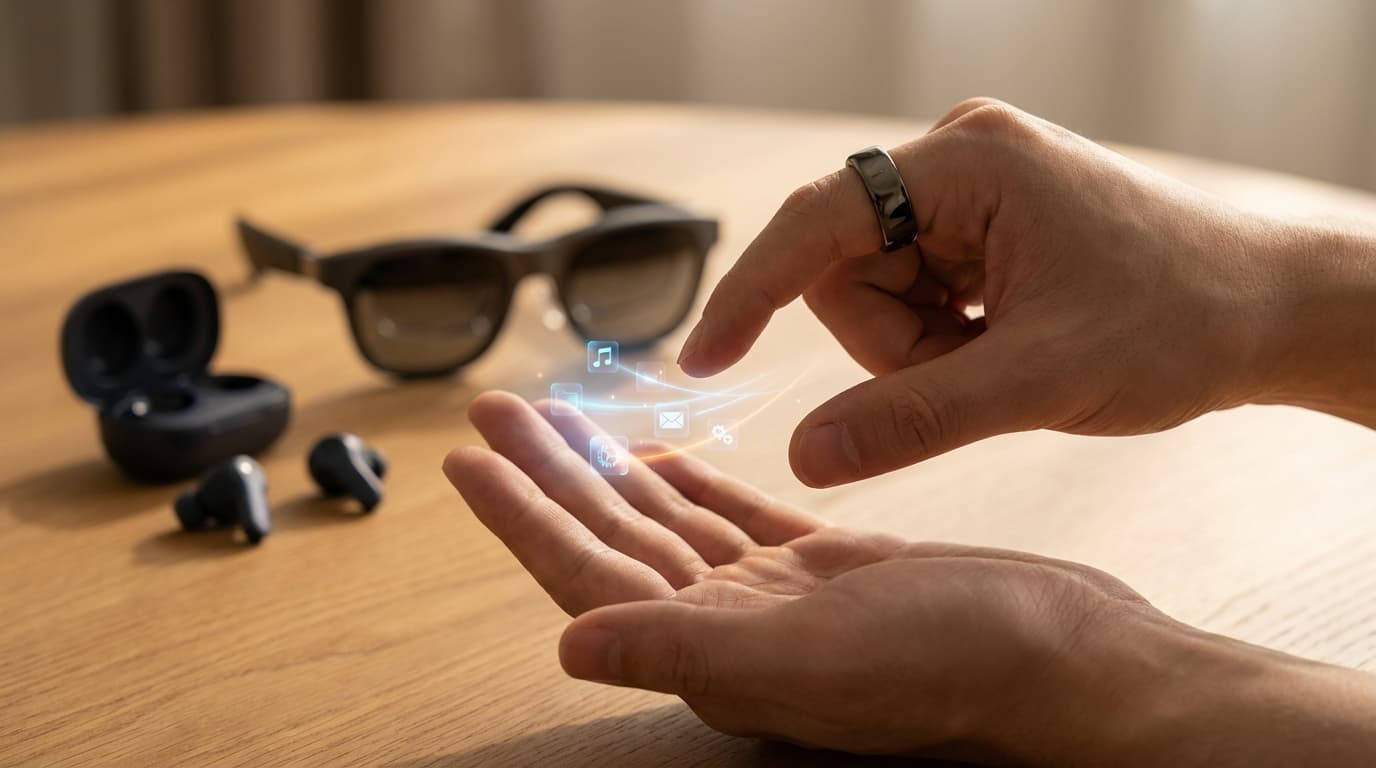
Yet for all its biometric fidelity, the ring has remained a passive observer. Interactions have been limited to companion apps and occasional haptic alerts, reinforcing a one-way flow of data: body to cloud. That dynamic is poised for disruption as on-body inputs gain prominence in augmented reality (AR) headsets, earbuds, and next-generation wearables. In this context, Oura’s March 5, 2026 acquisition of Doublepoint marks a deliberate pivot: embedding inertial-signal gesture recognition to turn the ring into an active controller, not just a health monitor.
Doublepoint’s Technology and Team Integration
Founded in 2020, Doublepoint specializes in extracting gesture events—pinches, flicks, taps—from accelerometer and gyroscope streams using lightweight machine-learning models. The startup’s four-person AI team, now joining Oura in Helsinki, has demonstrated sub-200 millisecond recognition pipelines that run entirely on-device. Oura’s announcement frames the deal as a step toward “gesture + voice-powered wearable AI” with privacy-first processing.
By folding gesture recognition into its stack, Oura aims to blend inputs with sensor fusion. Beyond discrete controls, inertial signals could enhance activity detection, reduce false positives in health analytics, and surface nuanced behavioral insights without shipping raw data off the ring. Doublepoint’s founders bring experience in embedded inference and signal processing, positioning Oura to reimagine the ring as both a health sensor and an interface conduit for broader device ecosystems.

Why This Matters: Shifting User Agency and Platform Power
The core insight is that input modalities shape the user–machine relationship. A ring that senses heart rate tightens the feedback loop between body and analytics; a ring that also controls AR glasses or music players extends personal agency into the ambient computing world. Oura’s move signals a reallocation of power: the device owner may gain more seamless control over connected hardware, but the ring manufacturer also accrues richer behavioral data and multiplies touchpoints across devices.
This shift invites questions about identity and meaning in digital interactions. When gestures become the interface, users no longer rely on screens or voice—tools historically mediated by platforms seeking visibility and engagement metrics. Instead, on-body inputs can preserve discretion and privacy. Yet they can also embed new surveillance vectors. As inertial-data gestures fuse with health metrics, the distinction between “control interface” and “biometric sensor” blurs, raising human-stakes debates about consent, inference, and the boundaries of self-quantification.
Technical and Operational Constraints
Gesture recognition on a ring intensifies challenges around compute budgets, power draw, latency tolerance, and robustness. Rings accommodate only milliwatt-scale processors and tiny batteries; every additional millijoule consumed by continuous inference risks degrading multi-day battery life that Oura’s customers expect. Sub-200 ms end-to-end responsiveness has become shorthand for “intuitive” gestures, but achieving this on a diminutive SoC underscores the need for highly optimized model quantization, custom inference engines, and potentially dedicated digital signal processors or specialized microcontrollers.

Calibration complicates robustness. Variations in finger size, ring placement, skin contact, and user activity profiles can alter inertial signatures, leading to false positives or missed gestures. Industry analysts anticipate that maintaining accuracy across millions of users will surface questions around personalized model updates versus one-size-fits-all classifiers. Oura’s approach—whether periodic on-device retraining, federated updates, or parameter tuning—will shape both user experience and operational overhead.
Privacy and Human-Centered Data Governance
Gesture-derived signals carry personal behavior patterns and, when fused with biometric data, could infer stress levels, emotional state, or sensitive routines. Oura’s privacy-first messaging frames on-device inference as a compliance safeguard, but it raises regulatory and trust considerations. In EU jurisdictions, for example, data protection authorities may view inertial-data gestures as “behavioral biometric data,” invoking stricter safeguards under GDPR. Enterprises planning ring-based pilots may encounter audit demands for data-flow diagrams, opt-in documentation, and algorithmic impact assessments.
Beyond legal compliance, human stakes center on how gesture logs might be retained, shared, or analyzed. Will users have granular controls to revoke or purge their gesture history? How will downstream partners—earbud, AR, or mobile-app developers—handle fused telemetry? The possibility of cross-device correlations opens questions about surveillance creep: could gesture patterns be linked to identity profiles or habit predictions that extend beyond personal health?
Competitive Landscape: Beyond Wrist Displays
As wrist-worn devices lean into richer screens and companion UIs, Oura is staking a differentiated path. Gesture rings promise glanceless control for audio playback, AR navigation, or smart-home commands—use cases where wrist displays add visual clutter or demand larger batteries. Yet rings inherently lack on-device screens and sizable compute headroom, meaning gesture input augments rather than replaces touchscreens or voice assistants.

Competitors such as Ultrahuman, RingConn, and legacy wrist-OEMs are evaluating similar inertial-signal frameworks. Some are pursuing multimodal wearables that combine ring, wrist, and eyeglass inputs to distribute interaction across the body. In this context, Oura’s acquisition raises the bar: it signals that gesture-input rings will be table stakes for wearables aspiring to ambient, hands-free experiences. As a result, platform alliances—between ring makers, AR vendors, and audio-hardware companies—are likely to intensify.
Risks and Governance Considerations
- Regulatory scrutiny around behavioral biometrics: The fusion of gesture and health metrics may attract data-protection inquiries, especially in regions with stringent consent regimes.
- Battery and reliability pressure: Continuous or intermittent inference could expose trade-offs between always-on capabilities and acceptable charge cycles, with user churn risk if runtime falls below expectations.
- Spoofing and accidental activation: Absent robust gesture-authentication safeguards, malicious or inadvertent gestures could trigger sensitive actions, raising safety and privacy alarms.
- Platform fragmentation: The value of gesture-enabled rings amplifies with ecosystem support—SDKs, APIs, partner integrations—but Oura has yet to publicize a developer playbook, which could stall adoption momentum.
Diagnostic Implications for Product and Security Stakeholders
Oura’s pivot prompts a fresh set of questions and concerns for enterprise buyers, regulators, and product strategists:
- Raises the need for examination of on-device compute budgets versus battery life targets—how will gesture pipelines affect expected ring endurance?
- Will surface questions around model calibration practices and personalization—what transparency will users have into their gesture-model updates?
- Drives inquiry into data-governance frameworks—what audit trails, opt-out flows, or revocation mechanisms will satisfy privacy and compliance benchmarks?
- Calls for scrutiny of cross-device integration security—how might gesture events be authenticated to prevent spoofing or unauthorized access?
- Spotlights partnership dynamics—what developer support and ecosystem alliances will determine the practical reach of gesture interactions in AR, audio, and IoT domains?
- Frames human agency concerns—how will the shift to on-body controls reshape user experiences, power dynamics, and identity in the ambient computing era?
What to Watch Next
- Announcements of developer resources—SDKs, APIs, or sample code—revealing Oura’s approach to ecosystem enablement.
- Product roadmaps or demos at industry events (Mobile World Congress 2026 is a likely platform) that showcase gesture-integrated ring prototypes.
- Patent filings or regulatory filings that illuminate technical safeguards, privacy controls, or gesture-data classifications.
- Early adopter and developer feedback highlighting performance limits, usability pitfalls, or privacy questions in real-world trials.
- Competitive moves from wrist-OEMs, other ring makers, or platform players exploring alternative on-body input modalities.
Oura’s acquisition of Doublepoint underscores a broader industry recalibration: wearables are evolving from passive data collectors into active interfaces that reshape human-machine relations. The realignment of input and sensing on a single device elevates questions of user agency, data power, and the meaning of on-body computing in an age where every gesture can become both a command and a biometric signal.