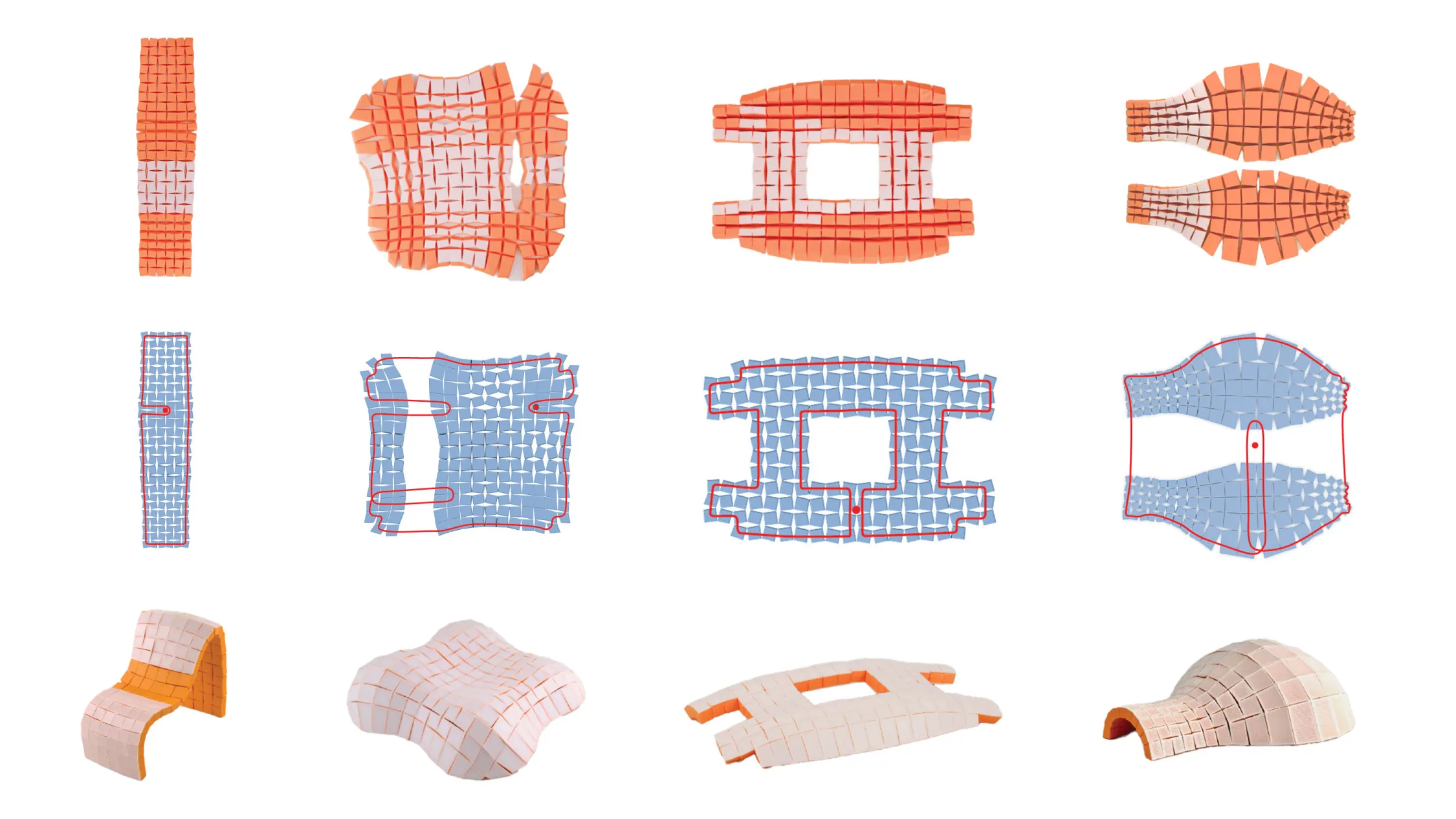
MIT CSAIL researchers have introduced a kirigami-inspired algorithm that encodes user-defined 3D shapes into flat sheets of interconnected tiles, which spring into form when a single, optimized string is pulled. This approach trades the complexity of multiple actuators or manual assembly for a single-tendon mechanism, but its practical adoption hinges on manufacturing precision, material durability, and comprehensive validation under realistic loads and environmental conditions.
Concept Overview
The team, led by Mina Konaković Luković (Algorithmic Design Group) with lead author Akib Zaman and postdoc Jiaji Li, frames the problem using kirigami-style tiles connected by rotating corner hinges. Their two-step algorithm (1) selects the minimal set of lift points the string must engage to achieve the target geometry and (2) computes the shortest, low-friction path linking those points and required boundary guides. Pulling the resulting continuous tendon sequentially rotates hinge corners, sculpting the flat sheet into the intended 3D form (reported by the team).
- Substantive change: reported reduction in actuation complexity from multiple motors or manual assembly to a single, precomputed string pull that both guides and locks the structure.
- Scale demonstrations: prototypes include a 3D-printed medical splint, a posture corrector, an igloo-like shelter, and a human-scale chair; compatibility with 3D printing, CNC milling, and molding is reported by the team.
Evidence and Grounding
Demonstration footage published in December 2025 shows 3D-printed cable-driven mechanisms embedding tendons for dynamic deployment. The researchers report that reversing the pull restores the flat configuration, indicating reversible actuation in these prototypes. However, quantitative benchmarks—such as deployment speed, friction coefficients, and fatigue-cycle lifespans—remain unpublished as of February 2026.

Open Questions
- No published benchmarks: key performance metrics for string friction, deployment timing, and lifecycle durability have not been disclosed.
- Load-bearing capacity: the strength and stiffness of rotating corner hinges, combined with tile geometry, will dictate maximum loads; human-scale applications (chairs, shelters) require structural validation against relevant codes.
- Environmental durability: exposure to moisture, abrasion, dirt, or UV may compromise string integrity and hinge behavior in medical, disaster-relief, or space settings.
- Automation gap: current prototypes rely on human-applied pulls; claimed progress toward self-deploying actuators lacks confirmed robotic deployment demonstrations.
Comparative Context
Traditional deployable systems often depend on multiple actuators, pneumatic actuation, or intricate crease-sequencing that require manual or automated control with several degrees of freedom. By displacing that complexity into offline string-path optimization and hinge design, the single-tendon method simplifies field operation to one degree of actuation. In exchange, it amplifies dependence on precise manufacturing tolerances and predictable frictional behavior.
Implications and Validation Needs
This string-driven paradigm offers potential advantages in flat packing logistics and reduced hardware complexity, but real-world adoption depends on rigorous validation. Critical validations include fatigue testing of tendon materials and hinge joints, structural load tests against human-carrying requirements, and environmental endurance trials for moisture, abrasion, and UV exposure. Medical-device or shelter certification paths will demand standardized mechanical and regulatory approval processes.
Claims of suitability for space missions, including deployment in Martian environments, remain speculative without published vacuum and thermal cycling results or robotic-actuation tests. Adoption depends on aligning manufacturing tolerances with modeled friction values, verifying consistent reversible deployments over repeated cycles, and expanding prototype scales to industry-standard benchmarks.
The single-string actuation concept reframes deployable-structure design with minimalist hardware, but its real-world impact will be determined by the ability to translate algorithmic promise into manufacturing realities and validated performance under demanding operational conditions.