Executive Summary
Sophia Space argues that sail-inspired, passively cooled TILE modules could boost the power-to-compute efficiency of orbital AI workloads, but their impact hinges on unvalidated thermal performance, regulatory constraints, and survivability concerns. Ground tests in 2026 and an Apex Space flight demo in late 2027–early 2028 will be critical inflection points.
Key Takeaways
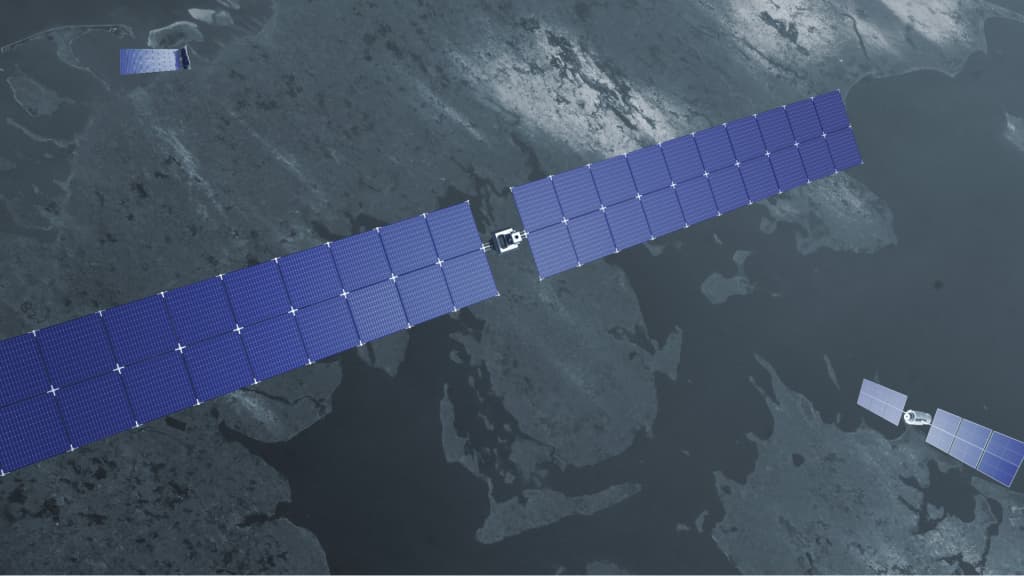
- Sophia Space repurposes Caltech/JPL solar-sail research into 1 m², few-centimeter-thick server “TILEs” that integrate photovoltaics and passive radiative cooling.
- The company claims that the thin form factor can direct 92% of generated power to onboard processing, though independent validation is pending 2026 ground tests.
- Roadmap milestones include ground thermal cycling and software load-balancing verification in 2026, followed by an orbital demonstration aboard an Apex Space bus in 2027–28.
- Uncertainties encompass large-scale thermal performance in vacuum, material degradation under radiation and micrometeoroid flux, and the complexity of tile-level thermal load management.
- National security procurement, export controls, insurance, and debris mitigation frameworks are likely to shape commercial adoption and strategic partnerships.
Breaking Down the Announcement
Sophia Space’s TILE concept melds three core elements: integrated photovoltaic cells for power generation, a thin conductive heat spreader that routes processor heat to radiative surfaces, and software orchestrators to balance thermal loads across units. In the vacuum of space—where convection is absent—the design trade-off is between heavy radiators and lightweight, high-conductivity structures that dissipate heat passively.
Sophia says its sail-derived geometry could slash structural and radiator mass while keeping high-power processors within safe operating temperatures without pumps or fans. The company claims a 92% power-to-compute ratio, which would represent a material efficiency lift over traditional radiator-centric architectures—but this figure remains subject to independent thermal validation in planned 2026 tests.
Why Now—Market and Technical Drivers
Two converging trends have elevated the stakes for on-orbit compute. First, high-resolution Earth-observation (EO) and intelligence satellites now generate terabytes to petabytes of data per revisit, creating an on-board processing bottleneck: downlink windows and ground pipelines struggle to keep pace. Second, defense and commercial space actors are explicitly funding low-latency inference in orbit to accelerate decision-making for mission-critical tasks—from missile warning to wildfire monitoring.

Lower-mass thermal solutions promise multiple value inflection points: reduced launch costs, higher payload fractions, and a greater share of onboard power allocated to compute rather than cooling. If Sophia’s TILEs deliver on their passive-radiation promise, operators could triage sensor data in situ, cutting dependence on expensive ground stations and enabling near-real-time analytics.
Comparative Context and Open Questions
Competing thermal-management paradigms fall broadly into radiator-heavy racks and alternative sail-inspired concepts. Radiator-centric designs are proven at moderate power levels but impose substantial mass and stowage volume penalties. Other solar-sail spinoffs, such as Aetherflux, pursue thin deployables but differ in structural approach and cooling strategies.

- Debris and durability: How will large arrays of centimeter-thick tiles withstand micrometeoroid impacts, UV erosion, and temperature extremes over multi-year missions?
- Passive cooling limits: Can conduction-only heat transfer support peak AI inference loads without localized hotspots or thermal runaway?
- Load balancing complexity: What is the operational burden of dynamic tile orchestration, and how does it interact with satellite bus power budgets?
Absent in-orbit flight data, these questions remain unresolved. The 2027–28 Apex demo will offer the first system-level glimpse, but broader adoption may hinge on third-party testbeds or industry consortia sharing performance telemetry and failure-mode analyses.
Regulatory and Governance Implications
On-orbit compute modules employed for ISR or missile-warning tasks will attract intense national security procurement scrutiny. Export-control regimes (ITAR/EAR) could restrict tech transfers, complicating non-U.S. partnerships. License approvals for satellite launches and spectrum allocation may extend timelines by months or years.

Insurance underwriters will assess TILEs through the lens of debris-mitigation protocols and failure-mode behaviors. A modular sail structure may present atypical tumbling or fragmentation risks compared to conventional box satellites, potentially raising premiums or requiring novel bonding and tether strategies.
Operator Perspectives—Likely Evaluations
- EO and ISR satellite operators are likely to view TILEs as a potential means to reduce downlink loads and accelerate in-orbit triage, while anticipating a protracted validation period before mission-critical integration is feasible.
- Defense procurement planners may see latency benefits in principle but will weigh classification constraints and lengthy certification processes against operational timelines.
- Cloud and platform providers assessing orbital edge compute may track Tile-demo telemetry carefully, treating it as a diagnostic barometer of system reliability and power-density gains.
Procurement Due Diligence—What Stakeholders Will Examine
- Thermal performance data and third-party validation reports, including radiation hardness and endurance under thermal cycling.
- Failure-mode documentation for micrometeoroid impacts, material fatigue, and sail-deployment anomalies.
- Export-control classifications, license application timelines, and collaboration frameworks with international satellite integrators.
- Insurance underwriting criteria tied to modular sail characteristics, debonding risks, and end-of-life disposal plans.
Milestones to Watch
- 2026 Ground Validation: Operators will likely require independent thermal validation data and radiation-endurance test results before considering pilot integrations.
Example edit: “Operators will likely require independent thermal validation data…” replaces “require independent thermal validation data…”
- 2026 Software and Load-Balancing Demonstrations: Observers will monitor software orchestrator performance under realistic compute-density scenarios.
- Late 2027–Early 2028 Orbit Demo: Pilots will probably focus on telemetry from a TILE payload aboard an Apex Space bus to assess real-world thermal stability and power throughput.
- Regulatory Sign-Offs: Export-control clearances and flight licenses are likely to emerge as gating factors, with timelines shaping go-to-market pacing.
Conclusion
The thesis driving this analysis is that Sophia Space’s sail-inspired TILE modules embody a diagnostic pivot in orbital compute: they target a longstanding thermal bottleneck without active cooling, potentially unlocking higher power-density inference in space. Yet the proposition is conditional. Independent validation of the 92% power-to-compute claim and system-level survivability data will determine whether TILEs remain a niche experiment or catalyze a broader shift toward sail-based, passively cooled data centers in orbit. The 2026 ground tests and the 2027–28 Apex demo stand as the decisive milestones for investors, operators, and procurement authorities assessing the future of on-orbit AI compute.