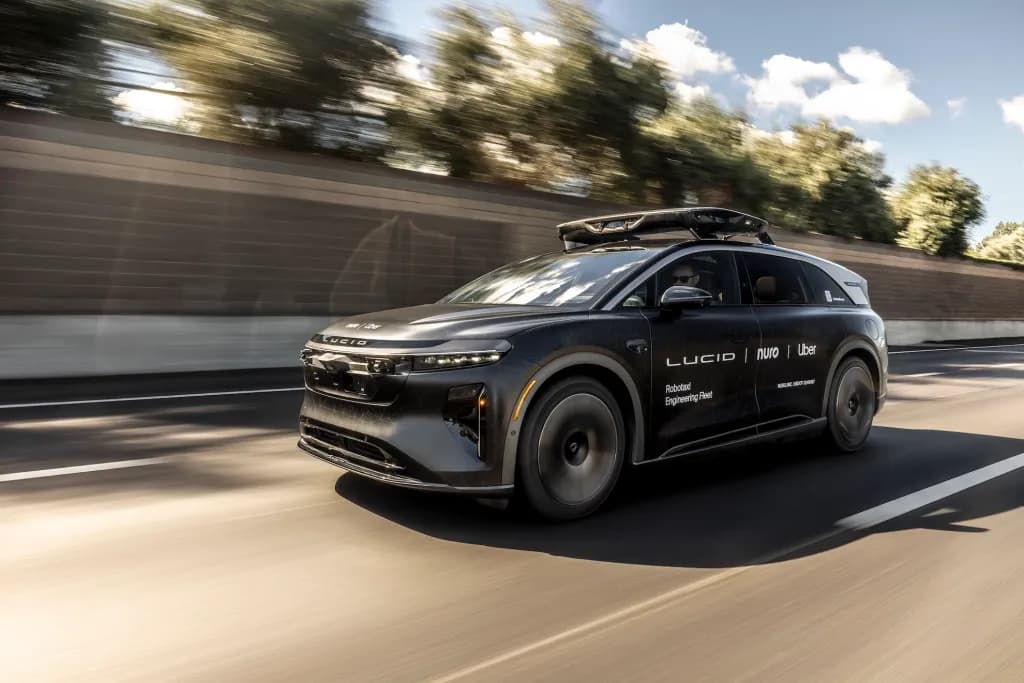
Executive summary – The operational pivot reshaping AV commercialization
On February 23, 2026, Uber introduced Uber Autonomous Solutions, a dedicated business unit selling end-to-end operational services for robotaxis, autonomous trucks, sidewalk delivery bots and drones. Instead of developing self-driving stacks, Uber will leverage its marketplace and infrastructure expertise—mapping, high-resolution training data, fleet financing, depot charging hubs, rider experience platforms and live remote assistance—to accelerate partner deployments and pursue cost-per-mile reductions.
This initiative repackages over a decade of on-demand transport competencies into a commercial operations platform, with company targets to support partner services in more than 15 cities during 2026 and a pledged investment of $100 million-plus in U.S. fast-charging hubs. The shift realigns Uber’s position in the autonomous mobility ecosystem, converting its marketplace muscle into a revenue stream that hedges against long-term driver displacement.

Breaking down the announcement
Uber Autonomous Solutions centralizes tasks that AV developers often treat as peripheral. Key offerings include:

- High-resolution mapping and venue/event datasets drawn from Uber’s multi-city ride-hail network.
- AV 2.0 system training data collected via specially equipped partner vehicles.
- Fleet financing, maintenance at third-party depots and capital support for vehicle procurement.
- Deployment of fast-charging hubs and pit-stop infrastructure, backed by a company-stated $100 million-plus commitment.
- User experience platforms—Uber’s in-car tablet interface, customer support and a remote assistance system that has previously drawn scrutiny over offshore operators.
Rather than building its own autonomous vehicles, Uber positions itself as the operational back-office for fleets it does not own, drawing on partnerships with Lucid, Nuro, Waabi, WeRide, Motional and others.

Quantified claims and speculative gaps
- Company targets: Expand partner robotaxi services to 15+ cities in 2026; invest $100 million+ in U.S. fast-charging hubs. Neither figure has been independently audited.
- Cost-per-mile reduction: Uber suggests its scale can drive down operating costs, but third-party benchmarks on mileage economics are not yet public.
- Deployment speedups and user satisfaction: Potential advantages are plausible given Uber’s demand generation capabilities, but remain unverified without external data.
Implications for industry stakeholders
- AV developers may gain a turnkey operations platform that offloads logistics, potentially speeding time-to-market and avoiding in-house build-out of support functions.
- Cities and regulators could see centralized accountability for rider support and incident handling under the Uber brand, raising new questions about oversight of remote assistance workflows and data sharing.
- Investors evaluating AV partners will likely scrutinize unit economics from early pilots of Uber’s services, seeking clarity on utilization metrics and service-level performance.
- Uber’s own business model is reshaped: marketplace expertise becomes a product that protects core revenue from long-term autonomous displacement risks.
Risks and governance considerations
- Incident responsibility: By outsourcing remote assistance operations—an element flagged in the “Breaking down the announcement” section—Uber may become the first responder in cross-border incidents, complicating liability and raising jurisdictional questions when operators sit offshore.
- Regulatory scrutiny: Federal and municipal authorities will examine workforce locations and data-sharing practices, particularly where Uber’s mapping and training data services could enable rollouts ahead of uniform safety standards.
- Channel conflict and antitrust optics: Serving as both a ride-hail platform for human drivers and the operations provider for autonomous fleets may create commercial tensions and invite competitive investigations.
- Unproven economics: The absence of independent audits on cost-per-mile and deployment benefits leaves open the question of whether Uber’s operational stack delivers sustainable margins for AV partners.
Competitive context
Uber’s managed-services approach contrasts with the vertically integrated models of Waymo and Cruise, which build both the software stack and operations in-house. By selling operations as a product, Uber emulates cloud providers that monetize infrastructure and platform expertise instead of manufacturing proprietary hardware, positioning itself between in-house AV operators and third-party fleet managers.