Industry 5.0 is being decided in spreadsheets, not factories
Industry 5.0 promises a clean break from the logic of Industry 4.0. Instead of just connecting machines, it claims to orchestrate AI, robotics, cloud, edge, IoT, and digital twins to augment human potential and support environmental sustainability. But the actual fault line isn’t between old and new technologies. It is between old and new ways of measuring value.
The core structural shift is this: as long as industrial transformation is scored primarily on cost savings and efficiency, AI will be deployed to squeeze more out of people and assets, not to deepen human agency or long-term resilience. The technology stack is evolving toward human-machine collaboration, but the accounting stack is not. That misalignment is already visible in how Industry 5.0 investments are prioritized, and it effectively decides whether humans sit in the loop as collaborators or as costs to be minimized.
The evidence: human-centric Industry 5.0 is the slogan, efficiency is the budget
The Industry 5.0 narrative is clear. It reframes automation from replacement to augmentation: humans plus “cobots” (collaborative robots), AI systems, and digital twins working together in real time. In this vision, repetitive and hazardous work is offloaded to machines, while humans supervise systems, make strategic decisions, and drive innovation. Environmental sustainability is not an afterthought but a central design constraint, with orchestrated data flows optimizing energy, materials, and waste.
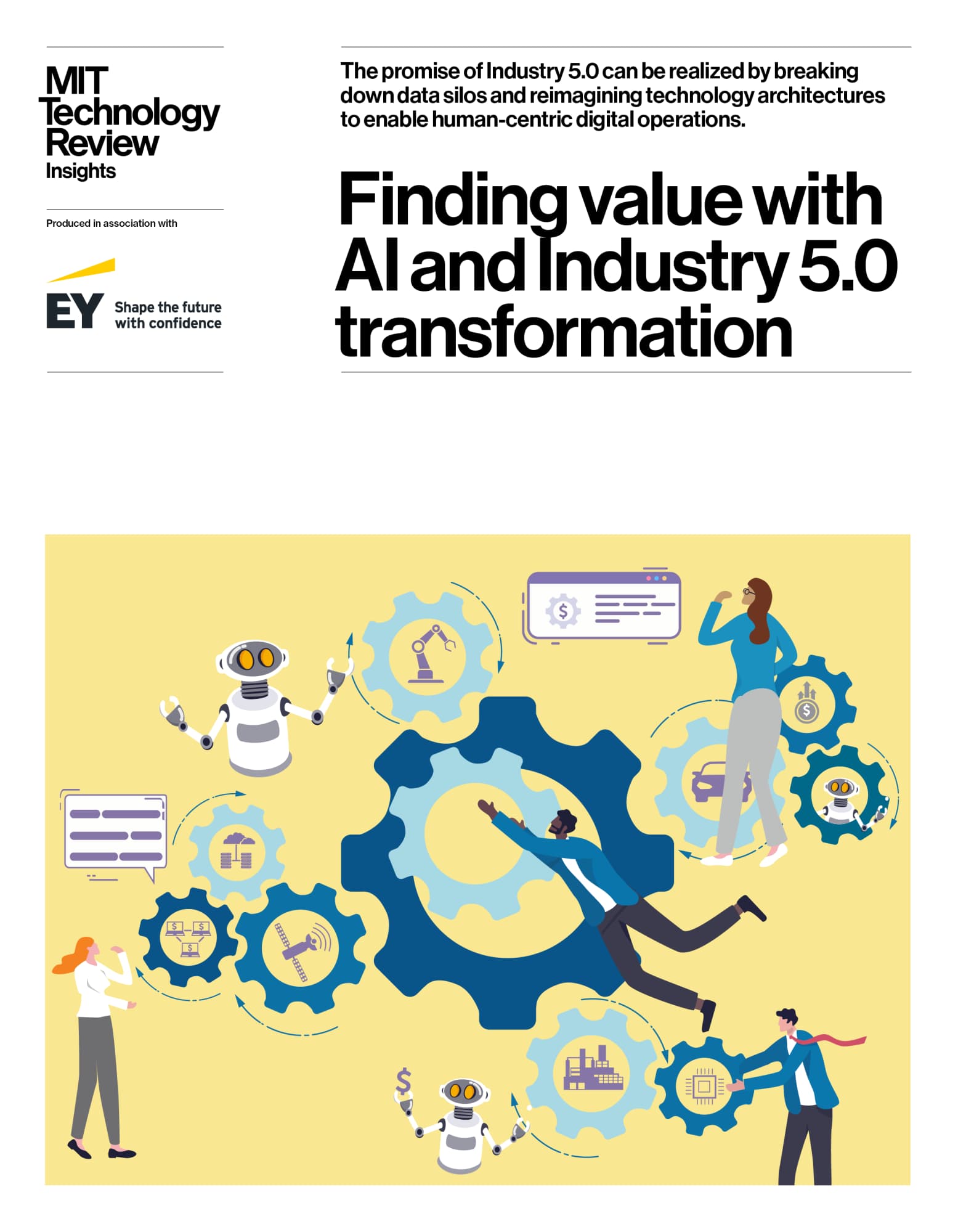
The MIT Technology Review Insights piece-supported by research from EY and Oxford’s Saïd Business School-explicitly describes Industry 5.0 as a move from merely integrating technologies to orchestrating them “to augment human potential, not just automate work, and enhance environmental sustainability.” It frames a “radically new level of collaboration between humans and machines” that should redesign infrastructure, operations, and resource use to “create new forms of enterprise value.”
Yet when 250 industry leaders were surveyed, the investments did not follow that story. The survey “reveals most industrial investments still target efficiency.” Despite the rhetoric, capital is still flowing overwhelmingly into classic use cases: throughput gains, labor productivity, uptime, and cost reduction. The same research notes that “human-centric and sustainable use cases deliver higher value” in principle, but they are consistently underfunded in practice.
The blockers identified are telling:
- Culture, skills, and collaboration gaps.
- Tactical and misaligned technology investments.
- Use-case prioritization that favors efficiency over growth, sustainability, and well-being.
EY and Oxford’s work reinforces the same point. The main barrier is “not only about fixing the technology,” but about “bolstering human-centric elements like strategy, culture, and leadership.” In other words: the tools are ready to orchestrate; the organizations are wired to optimize.
On the ground, even transformation champions are wary of aimless digitization. Chris Ware, general manager of iron ore digital at Rio Tinto, dismisses “chasing the digital fairies” and insists on being “very clear on what pieces of work we go after and why,” with each domain having “a unique roadmap about how to deliver the best value.” When “value” is implicitly equated with cost savings, those roadmaps skew toward narrow efficiency plays, no matter how collaborative the underlying technology might be.
External research around Industry 5.0 and industrial AI shows the same pattern. Cobots and human-robot collaboration are framed as ways to free workers for higher-value supervision and decision-making-but the surrounding economic logic is still about doing more with fewer people. Deloitte reports that U.S. manufacturers plan to allocate more than 20% of their budgets to smart manufacturing (AI, automation, analytics) as a top driver of competitiveness, explicitly to manage labor shortages and trade pressures. Agentic AI—systems that can act autonomously across workflows—is accelerating, with around 22% of leaders planning physical AI robots by 2027.
Meanwhile, the World Economic Forum’s analysis of over 1,000 industrial transformations through its Lumina platform finds that sustainability deployments combining multiple technologies can contribute directly to growth. But those are still the exception: lighthouse examples rather than the default pattern. Human-centric and sustainability-oriented use cases generate strong case studies; efficiency use cases still dominate the portfolio.
Put simply: the instrumentation of Industry 5.0—cobots, agentic AI, digital twins—is already oriented to support richly human collaborations. The investment flows that decide where those tools actually get used are still oriented to strip variability, reduce headcount, and compress timelines. The gap between promise and practice is not accidental; it is built into what “value” means inside industrial organizations.
The mechanism: when value = efficiency, orchestration becomes optimized automation
Why does this misalignment persist even as executives talk about human-centric Industry 5.0? The answer is structural rather than moral. It sits in incentive systems, measurement regimes, and organizational design.

First, industrial capital is governed by financial metrics that privilege short-term, quantifiable gains. A predictive maintenance system that can show a 3% reduction in downtime and a clear payback period fits perfectly into existing ROI templates. A cobot deployment that cuts the number of operators needed per line from four to two is easy to model as labor savings.
By contrast, a human-centric use case—say, using AI and robotics to redesign work so operators take on more cross-functional problem-solving, or a sustainability initiative that reduces emissions and opens access to new markets—produces value that is diffuse, delayed, and shared across functions. The benefits land in safety records, employee retention, brand perception, regulatory goodwill, and long-run resilience. These outputs are harder to price, and they rarely sit cleanly inside the budget of the unit making the investment.
So when project proposals enter the portfolio, efficiency use cases show crisp numbers; human-centric and sustainability ones come with narratives, scenarios, and uncertainty. In a system tuned for quarterly earnings and tight cost control, uncertain upside consistently loses to guaranteed savings. The survey’s finding that use-case prioritization skews toward efficiency is less a failure of imagination than a rational response to the way value is currently audited.
Second, the organizations that own Industry 5.0 transformations are structurally siloed. Operations teams are responsible for throughput and uptime. Finance teams are responsible for budgets and returns. HR handles skills and workforce development. ESG or sustainability teams are often advisory, with limited control over capital allocation.
Human-centric Industry 5.0 use cases sit awkwardly across all these domains: they require AI platforms, robotics, and data infrastructure (operations and IT); new training and job design (HR and line managers); and new metrics of success (finance and leadership). No single function “owns” them. In contrast, an efficiency project that automates a specific task within a production line maps neatly onto existing structures and can be justified within a single budget.
Third, vendors and technology platforms are pulled into the same gravity well. Leading industrial AI platforms emphasize unified data models, asset management, and phased rollouts from pilot to scale with tight governance—all attributes that make it easier to prove ROI in efficiency terms. Agentic AI vendors highlight use cases that remove repetitive human effort in back-office and production tasks, because those are the fastest paths to demonstrable financial outcomes.
Even when platforms support human-led transformation—multimodal AI that lets technicians diagnose faults with voice and images, for example—the selling story usually begins with time saved, errors reduced, and fewer truck rolls. The possibility that technicians might use these tools to expand their scope, develop new skills, or participate in redesigning workflows is, at best, a secondary argument.
Finally, culture and skills interact with measurement in a feedback loop. If workers see AI and cobots mainly deployed to accelerate existing processes and reduce staffing, they learn to associate “digital transformation” with precarity, not empowerment. Resistance grows. Management, seeing cultural friction, doubles down on top-down rollouts with narrow, easily controlled efficiency metrics. That, in turn, further limits experimentation with human-centric redesigns of work that would require trust, co-design, and new skills.
This is why the EY and Oxford research singles out strategy, culture, and leadership—not technology—as the blockers to realizing Industry 5.0. The orchestration layer exists, but it is orchestrating around one dominant key: efficiency. As long as that key defines what “good” looks like, Industry 5.0’s tools will behave like a more granular, more autonomous version of Industry 4.0 automation.
The implications: human collaboration becomes a veneer on machine-centered systems
If Industrial 5.0 unfolds under an efficiency-first value regime, several patterns become predictable.

First, “human-centric” will be defined minimally. It will emphasize safety, ergonomics, and basic well-being—important concerns, but still framed as ways to ensure reliable production rather than as sources of new capability. Cobots will handle lifting, welding, and repetitive assembly; humans will monitor dashboards, intervene on anomalies, and maintain the systems. This is collaboration in the narrow sense: humans as exception handlers inside machine-dominated processes.
Second, the labor narrative around AI will tilt toward substitution, masked as augmentation. Because budget justifications lean on headcount reduction and productivity gains, the net result is fewer workers managing more systems. The promise that freed capacity will be reinvested into upskilling, innovation, or new forms of work remains mostly rhetorical without a metric that captures the value of those reinvestments.
Third, experimentation with new business models—especially those grounded in sustainability—will remain confined to flagship plants and “lighthouse” initiatives. The WEF’s findings that sustainability drives growth where multi-tech deployments are embraced will be used to produce impressive case studies, but without a corresponding shift in how mainstream projects are scored, they will not set the norm. The spread of these practices will depend less on their technical success and more on whether they can be re-described in familiar efficiency language.
Fourth, agentic AI will quietly become the new substrate of management. As these systems take on planning, scheduling, and optimization tasks across back-office and production, the space in which humans make consequential decisions narrows. Operators and line managers increasingly act as supervisors of AI-driven workflows rather than designers of systems. Their expertise becomes encoded in models and then abstracted away, even as the rhetoric continues to celebrate “human-in-the-loop” decision-making.
Finally, the skills gap will deepen in a specific direction. There will be growing demand for a small class of highly skilled roles—AI engineers, systems integrators, data architects, industrial designers of human-machine interfaces—while broader workforces receive narrow training in how to operate and comply with AI-structured processes. In the absence of investment in broader human-centric outcomes, workers are unlikely to gain the autonomy or breadth of capability that Industry 5.0’s vision implies.
The net effect is that Industry 5.0, under an efficiency-centric measurement regime, behaves less like a revolution in human-machine collaboration and more like a refinement of automation. The orchestration of technologies increases, but the distribution of agency does not shift in favor of humans. It simply becomes more fine-grained, more data-driven, and more opaque.
The stakes: who gets to define “value” decides what humans become in Industry 5.0
The battle over Industry 5.0 is not just about which platforms win or how fast factories digitize. It is about who controls the definition of value in a world where machines increasingly execute what humans design.
If cost and efficiency remain the primary currencies, human workers are structurally positioned as friction: sources of variance to be minimized, substituted, or tightly constrained inside AI-optimized workflows. “Human-centric” in that world means preserving enough well-being and engagement to keep the system running, not expanding the space where human judgment, creativity, and moral choice matter.
If, instead, value measurement expands to explicitly include growth, resilience, skill formation, and environmental impact, then Industry 5.0’s orchestration tools become something different: instruments for compounding human capability rather than compressing it. In that scenario, cobots and agentic AI don’t just execute tasks more efficiently; they rearrange who gets to see the system, change it, and benefit from it.
Either way, the identity of industrial workers, engineers, and managers will be reshaped. They will become either operators of systems whose goals are fixed elsewhere, or co-designers of systems whose notion of “value” they help define. Industry 5.0 technology is flexible enough to support both futures. The constraint is not what AI can do in the factory, but what the spreadsheet is willing to count.